Introducing Edda
Welcome to my first blog post about Edda, a Norse fantasy roleplaying game set in a world where Ragnarok did not go according to prophecy. Instead, the nine worlds were fractured and the Jotuns took over what was left of Midgard. Edda is about fighting tyranny and choosing between saving people or restoring the broken world.
My ideas for Edda started while I was working on a Viking Age roleplaying event about the Christianisation of Scandinavia. I mentioned to my friend that the concept was provided to the design team by the venue. He asked me what I would make if it was just up to me and I said:
A Norse fantasy set after the Jotuns have defeated the Aesir, but before the world has been reborn. Tyrannical leaders subjugate all others and rule Midgard. Heroes have to go on an adventure using shards of Bifrost to travel between fragments of the nine worlds, in search of the Key of Yggdrasil to rebirth the world.
My friend replied that it sounds like a really cool tabletop campaign. He was obviously onto something, however my mind was not quite there yet. With a small team I made Fimbulvetr, another larp, that ran in 2024. It marked the start of Edda’s setting.
It is set on the last night of the mighty three-year-long winter from Norse mythology when “brother will fight brother”. In the larp, nine surviving human clans were called to a gathering by seidr visions, to perform a final blot sacrifice. While valkyries, in the guise of wrathful spirits, processed them to fight amongst each other in order to send as many warriors as possible to stand alongside the Aesir during the final battle. As the players discovered it was indeed not Aesir that had called them to blot, but Jotuns who sought to avoid their end in the last battle. They bargained with the humans, offering power in exchange for opening the way to safety in Midgard. An offer that some agreed to.
I got ideas for more events in this setting, but right now I want to devote my spare time, creative energy, and production skills to creating Edda. This site and these blog posts will document my journey as it evolves.

The Setting
Yggdrasil burned, the nine worlds are broken and shattered. Powerful Jotuns killed the gods and took their place. In the center of Ginnungagap floats what is left of Midgard, a large plate covered by ocean and islands. Here tyrannical Jotunsworn, worshippers of the new gods, have risen to power. Their factions wage war amongst each other for dominion over what is left of the world.
Ordinary people, living ordinary lives, suffer under tyrannical rule. Major settlements are ruled with an iron fist and strict laws are enforced by the leaders with mystical powers granted by the Jotuns. Small towns and villages pay taxes to the nearest Jarl, King or Queen for protection they never get. It is a harsh world where everyone needs to defend themselves and the resources are scarce.
Yet there is hope. A new prophecy speaks of the world’s rebirth. Shards of Bifrost, can be used to travel beyond the edge of Midgard. Out there, somewhere among the world fragments are the lost hall of Valhalla, where can be found the Key of Yggdrasil, a seed to rebirth a new world tree. However, the Jotunsworn do not want the world reborn, thus they hunt down people who have seidr visions.
You are a hero, or at least you will become one. One day the tyrants reach your home, and you find yourself called to action. On your adventures you are faced with constant choices between fighting for people in need, and a quest to rebirth the world.
The Game
As a roleplaying game, Edda should support the stories the setting affords, and aim to create the experience the game masters and players expect from the Edda storyworld.
The world of Edda is oppressive and the story needs the heroes to make meaningful and impactful choices, so the rules should encourage and reward the players when they make decisions based on their characters. It also means that the system needs ways to support the GM in responding when the story takes an unexpected turn because of player choices.
The stories of Edda involve adventures, deadly fighting and desperate situations, so the rules should make action feel dangerous, and fast-paced.
The player characters of Edda begin as everyday people who become heroes, so the character creation could focus on personality and motivation rather than combat abilities. It also enables a play experience of learning the rules while you play.
While Norse mythology is full of magic, it is not in the style of combat spells from traditional fantasy TTRPGs. Norse fantasy to me is more about enhancement, herbal mixtures, and rituals. Edda should provide mechanics for these kinds of mysticism.
Here are some of the concepts I am currently working with, everything is, of course, subject to change at this early stage.
- Five thematic stats used for all actions and checks/tests. Strength for might and brawn, Agility for finesse and speed, Cunning for wits and logic, Instinct for insight and aim, and Spirit for willpower and presence.
- Fate, as XP, is earned by making meaningful character decisions based on personality and motivation. Players advance their characters by spending Fate to permanently increase stats and learn abilities in moments of need.
- When it comes to combat, I am testing alternating initiative. One of the heroes starts, unless they are surprised and turns then shifts between heroes and their enemies, one turn per side. Attacks are done by rolling your weapons damage die, adding your bonus, and subtracting the target’s defence. Crits decrease defence.
My goal is to build a system that supports Edda’s setting and I enjoy running. My dream is that it will also inspire you and others to the parts you like into your own games.
About me
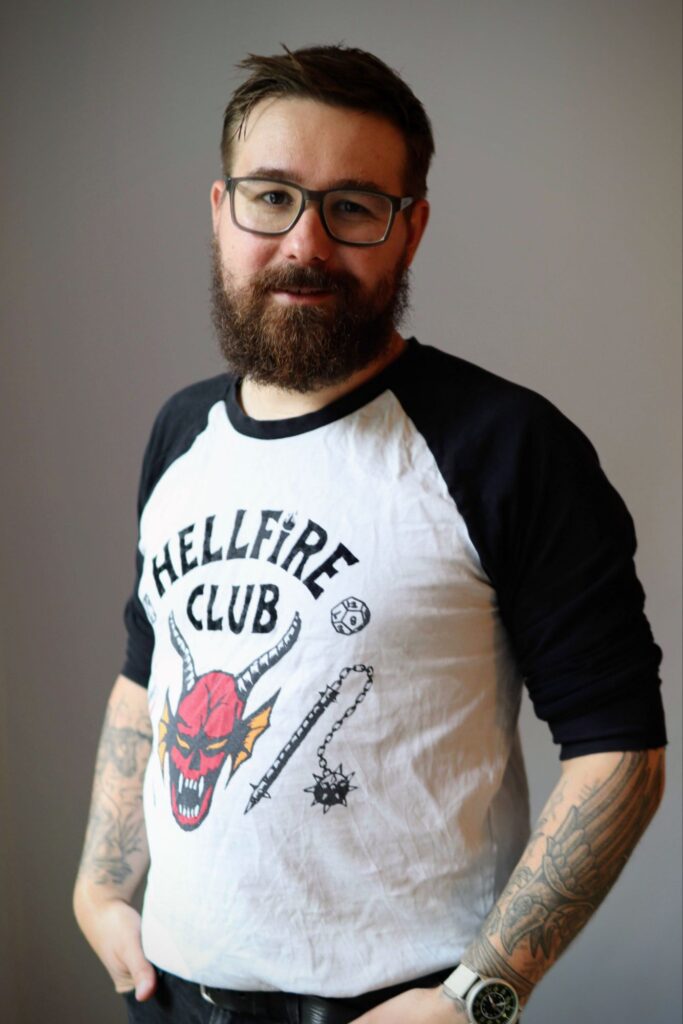
I’m Halfdan Keller Justesen, I live in Copenhagen and am educated as a design engineer. I work with democratic education, facilitation and event management in a national student union. For the last nine years I have spent most of my spare time organising immersive roleplay events in the Nordic larp community.
Tabletop is one of my favourite hobbies, and I even worked at an afterschool program as a GM for some time. I am excited to try almost any system. I mostly enjoy running games that are simple and straightforward, but at the right table I am not afraid to get crunchy. What really speaks to me are rules that are designed to facilitate an immersive experience. I want to make Edda into a game that keeps the flow of the story and facilitates dramatic scenes and where character choices shine.